
Tradition can be a fine, fine thing. We can learn from traditions, benefit from traditions, pass on traditions and these can all be good things.
But tradition itself does not guarantee a practice is a good thing. There are good traditions and bad traditions and those in between.
I say all of this because I was recently reading a person on the internet who was wrong. (ha!)
This person (and there are many like this person - again, it's the idea that I'm speaking of, not the person) was bemoaning the fact that churches don't tend to keep children in their church services. Instead, they coddle them by taking them out for their own "special service," and thus deprive them, they contended, of the benefits of learning to sit through and endure a church service that means very little to you.
The reason, of course, this person wanted to see kids sit through church services was because the Bible is so clear on the point. "Thou shalt keep the little ones in the synagogue, yea even though the little ones are bored out of their skull..."
No, wait, that's not right. In fact, there is no biblical demand to keep children in a service or, in general, to treat them as adults to make them learn by sheer repitition the value of sitting through something that makes no sense to them.
No, the reason that this person wanted children to sit through services was because of all the pedagogical studies that show the benefit of forcing children to sit still and listen to stuff that makes no sense to them in the learning process.
Wait, that's not right, either. There ARE no such studies.
In fact, as far as I can tell, there was one reason and one reason alone that this person wanted children to remain in their church service: It was the way they were brought up and if it was good enough for kids back then, it's good enough for kids today.
Tradition.
This person said...
I come from an older generation. When we were kids, we went to church with our parents. We sat quietly and listened or doodled or something, but we sat there.
Me, too. I'm from that generation, as well. I remember that tradition.
But what is the logical or biblical or pedagogical reason for this? None, so far as I can determine.
I mean, the reasoning is, "IF they learn to sit through this and be still now, while they're kids, then they'll be able to sit through boring sermons in the future, too."
And there IS some value, I think, to learning patience and to endure through things, even things that are extremely boring and irrelevant to you. But is forcing kids to sit quietly through a service a good way to do this?
I don't think so.
This person reasoned...
I don't believe it's because the kids won't understand the preaching. I think it's because the kids will disrupt the preaching. I don't think it's because the children aren't mature enough to understand. Nor do I think it is less than valuable for them to remain. It's my conviction that the primary reason children are dismissed from church services at the edge of the sermon is that they lack the discipline not to be a distraction to the people around them. It's not a maturity problem or even that kids are better taught at their own age level. It's a parenting problem.
Of course.
This person goes on to concede...
You know, under the age of 1 with nursing and all, I can imagine the need for a nursery. I was thinking more of the age where kids are being taught, not simply present.
So, at 18 months, apparently, this person thinks that children can be effectively taught something in church services and they lament that parents no longer see the value in raising children as this person was raised.
The thing is, EVEN THOUGH, learning to sit and learn can be a good thing, we don't ask five year olds to sit through a physics class, insisting they be relatively still so the adults around can learn what is being taught. We don't ask two year olds attend and sit quietly through a medieval history class. There is the concept of age-appropriate material and teaching styles that are suited for children of particular ages.
When we force most kids to sit through class after class (in a church service or a school or wherever) and endure something that is being taught in a manner that is over their heads, time after time, most kids DO learn something: They learn, "BOY! That's boring! I don't want NOTHING to do with that!"
How much better to take children out of a church service (or other adult-themed class) and teach them something they CAN learn in a teaching style suited to children, not to adults? My concern would be that we're teaching kids the wrong things when we teach them in the wrong way.
There is something to the concept of age-appropriate teaching and just because it isn't in your tradition to have age-appropriate teaching does not mean that your tradition is right.
I think a good question to ask is, "Is there any logical, biblical, study-based, common sense reason to believe this tradition is a good one?" and if the answer is No, then perhaps it's time to let that tradition go, or at least quit suggesting that people are wrong for following a tradition simply for tradition's sake.
Tuesday, May 24, 2011
Thoughts on Tradition and Learning Styles

Sunday, May 22, 2011
Earth Day 2011
Thursday, May 19, 2011
Bike to Work...
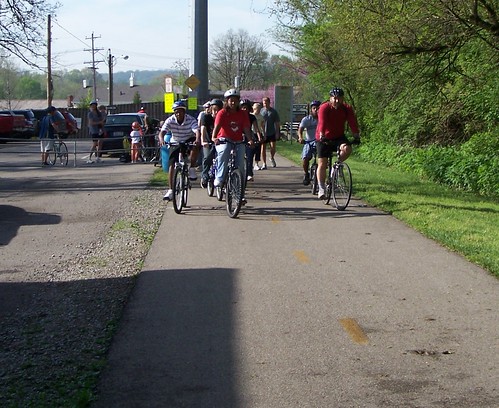
...to school, to church, to play, to shop...
Tomorrow, we in Louisville celebrate Bike To Work Day and it is a good day to recall that, as Grant Peterson noted, the bicycle is "rideable art that can just about save the world."
An astounding claim, but not a hyperbolic one, I'd suggest.
It's also a good time to recall how important bicycles were at least for a small part of our history. Here, I'll quote from a fine essay from the American Studies website at the University of Virginia...
Amongst the bicycles most important, and perhaps most enduring, legacies is its effect upon women's issues; indeed the mark the bicycle left upon gender relations in the 1890s is difficult to underestimate. One must remember that the America of years past was one of rigidly defined gender roles, with distinctly separate spheres of activity for men and women. The distinctions between the sexes were certainly as rigidly defined as ever in the years leading up to the 1890s--the years we popularly refer to as the Victorian era.
However, as the 19th century came to a close, women were gradually making headway into the male-dominated public sphere, through increased roles in education, social and political organizations. Perhaps as a response to the seemingly increasing potential for equality amongst the sexes, men begin to more and more delineate themselves in terms of physical prowess. Cycling, then took its natural place amongst football, baseball, and other male dominated spheres of activity. One can imagine the indignation, often expressed in terms of health or morality, that many a male felt when the woman was shown to be just as adept at handling the cycle as her counterpart.
Simply put, the bicycle allowed for movement into new spaces, literally and figuratively. The woman of the 19th century who had been given little opportunity to cultivate or express her autonomy now had a vessel with which one could not only develop autonomous power, but do so while leaving behind the old reliance upon men for travel. It's easy to see then, why Susan B. Anthony, women's rights advocate and future star of an ill-fated dollar, was to say that the bicycle had "done more to emancipate women then anything else in the world"...
Rational dress aside, the bicycle, despite being heaped with scorn by outraged men, was consistently trumpeted by progressive women as a tool for increased freedoms. Indeed, many feminist tracts of the day frequently invoked the bicycle as a metaphor for increased self-control... the author of Bicycling for Ladies, Maria Ward, bluntly notes that "Riding the wheel, our powers are revealed to us...".
Ride or DieIt is precisely this sort of attitude, empowerment coupled with visions of an increasingly egalitarian future, that angered many men greatly. Simply put, the woman on wheels was a threat to the well ingrained system of practical inferiority that men had been taking advantage of for centuries, and outraged men were quick to point to the bicycle as a threat to the social order. The cycle, it was argued, would disrupt the delicate sphere of the family unit by allowing the woman to travel beyond her previous limits without the surveillance of a knowing husband nearby. The younger woman, too was vulnerable to a bicycle induced lapse in morals, for it allowed her to stray farther a field with members of the opposite sex during courtship.
The leveling effect acheived by the woman on the bicyle was so great that the coming of the automobile and subsequent demise of the bicyle can be though of as a major step backwards for women's empowerment.
So, take an historic stand. Ride a bike. Save the world.
Monday, May 9, 2011
Grace in the Benefit of the Doubt
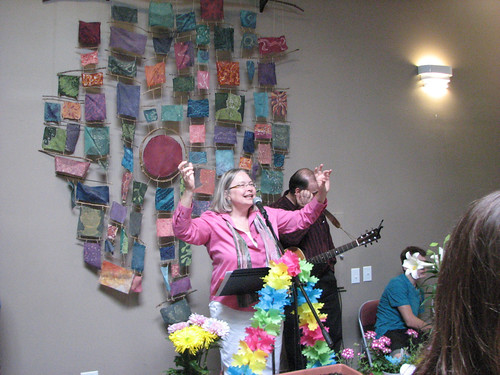
I am posting the bulk of my pastor's sermon from yesterday. I usually post these church-y types of things on our church blog, but it is so fitting in light of recent conversations around here that I wanted to post it here.
Our services tend to have two types of sermons/services:
1. Those that are powerful, gripping and dripping with God's grace and challenging us to walk by grace in the steps of Jesus, and
2. Those that are even MORE powerful, gripping and dripping with God's grace.
This is one of the latter sort... at least it was for me.
======
On the evening of that first day of the week, when the disciples were together, with the doors locked for fear of the Jewish leaders, Jesus came and stood among them and said, “Peace be with you!” After he said this, he showed them his hands and side. The disciples were overjoyed when they saw the Lord.
Again Jesus said, “Peace be with you! As the Father has sent me, I am sending you.” And with that he breathed on them and said, “Receive the Holy Spirit. If you forgive anyone’s sins, their sins are forgiven; if you do not forgive them, they are not forgiven.”
~John 20
It’s interesting to me that out of all the things that the Risen Christ might have said, maybe did say to his cowering in fear disciples, that out of all the blessings, out of all the charges that he could have given, that the one that the author of John reports is about forgiving and retaining sins.
If you forgive the sins of any, they are forgiven; if you retain the sins of any, they are retained.
I’ve always wondered what he meant by that. And I’ve shied away from ever really preaching about it because on the surface it kind of sounds like the Risen Christ was giving the church the power to forgive or to not forgive sin, to decide who is in and who is out, who is clean and who is unclean, etc. And I, for one, have not been very happy with the church’s record in that regard.
I grew up believing that God didn’t forgive you until you said a special little “please forgive me of all my sins, Jesus” prayer, which meant that the large majority of the non-Southern Baptist world, having not said that particular prayer, was left unforgiven. I’m exaggerating about that a little bit, but not much.
But what I’ve realized along the way is that this statement isn’t about the church’s power to forgive sin or to not forgive sin. It’s about Christ’s power to forgive sin, and about the church’s power through Christ to proclaim the forgiving love of God, and to live as forgiving and forgiven people.
Martin Niemoeller talks about Easter as the “unexpected act of the living God, which interrupts and runs counter to the uniform rise and fall of the world’s rhythm.” Talk about running counter to the uniform rise and fall of the world’s rhythm — some of us experienced that this week, didn’t we, when our world was cheering over the death of Bin Ladan, and we were saddened, or if not saddened, concerned, or if not concerned, at least ambivalent over the violent death of, yes, we can say it, one of God’s children.
I attended part of a conference at Louisville Presbyterian Seminary on Monday morning, and there was a part of the worship service where people were voicing prayers aloud, and as I was struggling to find words to express a prayer about our response to the death of Bin Laden, someone else simply prayed, “God, give us the courage to forgive our enemies.” It was perfect, and I was grateful to be in a setting where people were seeking to love, seeking to not gloat, to not rejoice in the demise of another, however dastardly that other was. I was grateful to be in a community where the uniform rise and fall of the world’s rhythm was interrupted by a great jolt of forgiveness.
Of course, it’s easier to gloat, to not forgive. But thankfully, Craig Barnes reminds us that “we are not on our own for this. Jesus gave us the Holy Spirit before he called us to forgive. The work of the Spirit is to bind us into the work of Jesus Christ. What this means is that we disciples are not called to produce forgiveness. We’re called to be the priest pronouncing that which has been produced on the cross...”
Jesus’ charge to the disciples was to carry on the work that he had started. I am thinking of the woman caught in adultery. The crowd was ready to stone her, but Jesus said, “Let the one among you who has never sinned cast the first stone.” I am thinking of the story of when Martha came out of the kitchen madder than a wet hen because Mary hadn’t been lifting a finger to help cook, and Jesus defended Mary. “Mary has chosen that right thing,” he said. And later, when Judas jumped all over Mary for wasting an expensive bottle of perfume to annoint Jesus, and once again Jesus defended her.
It seems to me that one of the things that Jesus did consistently through the Gospel of John was to give people the benefit of the doubt, to take what others saw as “sin,” as “shortcoming,” as “uncleanliness,” and to reinterpret it.
In the story of the woman caught in adultery, he didn’t downplay the seriousness of the woman’s sin, but he did put it into context for everyone there: “Let the one who is without sin cast the first stone.” Yeah, okay, she sinned, but really who hasn’t? And in the stories of Mary, with Martha, and with Judas, he reinterpreted Mary’s actions, which were seen as negative by others in both cases, Mary should have been working in the kitchen, fulfilling her role as a woman, right, and Mary shouldn’t have wasted so much money on one lavish act of love, right, he reinterpreted her actions, and pronounced them good, pronounced her good. “Wherever the gospel is preached, she will be remembered.”
And it strikes me that while the forgiveness that we usually talk about is, I will forgive you for what you have specifically done to me, that it’s broader than that. It’s an approach to the world, it’s a lavishness, a liberality, an automatic giving of the benefit of the doubt. It’s a willingness and not just a willingness, but a habit of going deeper, of looking beyond and beneath, of seeing people, not just in light of what they’ve done, of how they’ve screwed up, but through the eyes of someone who truly loves them...
If you forgive the sins of any, they are forgiven; if you retain the sins of any, they are retained.
If we look at people through a stingy, judgmental lens, we are retaining their sins, accentuating their failures, perpetuating their sense of shortcoming. But if we look at people through a lens of grace and tenderness and love, then, poof, it’s no longer their shortcomings that are foremost in our minds, and maybe, just maybe not in their minds, at least for awhile, either.
What is that verse in 1st Peter? “Love covers a multitude of sins.”
Of course, we can proclaim forgiveness, live in a spirit of forgiveness and grace and still not seem to make much a difference in the lives of those around us. But we can be assured that the one place that it will make a difference is in our lives.
In his book about South Africa’s Truth and Reconciliation Process, Bishop Desmond Tutu tells the following story: A recent issue of the journal ‘Spirituality and Health’ had on its front cover a picture of three U.S. ex-servicemen standing in front of the Vietnam Memorial in Washington, D.C. One asks, “Have you forgiven those who held you prisoner of war?” “I will never forgive them,” replies the other. His mate says: “Then it seem they still have you in prison, don’t they?”
Bishop Tutu says that forgiving does not mean forgetting and it does not mean condoning. It does not mean minimizing what happened or not taking it seriously. And I would add that it does not mean going back to an abusive partner or putting yourself in a situation where you will be used or taken advantage of. What it does mean is, says Tutu, is “drawing out the sting in the memory that threatens to poison our entire existence.”
Eugene Peterson, in his paraphrase of scripture, The Message, interprets it like this:
"If you forgive someone's sins, they're gone for good. If you don't forgive sins, what are you going to do with them?"
Craig Barnes, again, says, “If we do not forgive those who hurt us, the only alternative is to retain the sins. To retain means to hold, and to hold onto hurt is to lock ourselves into the identity of victim. In the words of Lewis Smedes, ‘When you forgive you set a prisoner free. And then you discover that the prisoner was you.’"
On Easter, Karen mentioned the movie that some of us had gone to see the day before, “Of Gods and Men,” about nine Catholic priests who chose to remain at their monastery in Algeria even though they knew that their lives were in danger due to a rebel-led insurrection against the government. In one of the most on the edge of your seat scenes, the rebels, who had previously executed a number of foreigners in the same town, force their way into the monastery to demand medical care and supplies.
Brother Christian, the leader of the priests, refuses to send the elderly doctor with them, saying that he is too feeble to make the journey and that they can come to the clinic instead. He also refuses to give them medicine, saying that their supplies are low, and that the villagers need them. The rebel leader says, “You have no choice.” And Brother Christian, knowing that he could be shot to death any minute, replies, “Yes. I do.”
The people of the Risen Christ know that we always have a choice. Not in what happens to us, but in how we respond. We can choose to love, we can choose to walk the second mile, we can choose to turn the other cheek, we can choose to forgive, we can choose to live powerfully as the people of the Risen Christ, defined only by love, controlled only by love.
We have a choice. We are free.
Wednesday, May 4, 2011
Irony

IRONIC FUNDAMENTALIST COMMENT OF THE DAY:
Warning: Be sure to save your comments if you post at [Mr X's] site. He has a history of deleting comments, only to then lie about what the comments really said. Should we be surprised that a false teacher would do such a thing?
This was said by a Religious Right sort of dude who routinely moderates, deletes and bans those who disagree with them and has set up a whole blog dedicated to lying about people's positions, twisting their words and comments and, of course, refusing to allow them to defend themselves!
Is it really possible that this person fails to see the irony?
It truly is amazing how consistently - at least in my tiny little corner of the blogging world - that there is ONE group of bloggers that ban and moderate comments: The Religious Right (or maybe Christian Fundamentalists is the better descriptor?).
There ARE exceptions - Marshall, Doug and Chance (and John, when he belonged sort of to the Religious Right) allow people to make comments and are prepared to get in there and discuss their views and our views without feeling the need to moderate or delete or ban outright. Good for them on this point, if nothing else.
But beyond those few hearty souls, religious right blog after religious right blog, nearly down to the man (and it IS almost always men), either moderate or outright ban and delete comments from those who disagree too much on the wrong topics.
Why is that?
I tend to call it cowardice - that they're afraid to engage with those with disagreeing opinions - that they're afraid to let people defend their own arguments, scared that other people will be won over by the "false teachings" of "heretics" and "pagans." But they DO engage in SOME conversation, even if only for a little bit, with people they disagree with. So, they're not totally averse to having conversations with those who disagree.
But sooner or later (oftentimes sooner), the ban comes down, the moderation goes up.
Or, truly, many, many of these sites have moderation on right from the get-go. They want to be the gatekeeper to approve only those messages that they deem worthy (based on what? one wonders).
So, there IS an element of fear in their moderation/banning, but I don't think that's exactly the right word. Intellectual laziness, perhaps - they don't want to have to spend TOO much time defending their position - that might be part of it, at least for some of them.
But is there a more apt term for that sort of behavior?
And worse, what of those who will spend whole threads demonizing/twisting/slandering/gossiping others they disagree with and then refuse to allow that person to defend themselves?
What IS the best word for such despicable behavior?
Cowardice? Intellectual laziness? Anti-intellectualism? Ungentlemanly or Unseemly (those both seem way too mild)? Indecorous? Untoward? Indecent??
I'd love to see some study into how widespread this phenomena is (after visiting dozens of such sites, personally, I'd say I've seen it in at least 90% of them) of banning/moderation by the religious right (or fundamentalists) and how it compares to those who are not more fundamentalist in nature?
It would also make for any interesting psychological study, I'd think.
Friday, April 29, 2011
Whatsoever Things are Lovely

I've lately been in another discussion on marriage equity at another blog. This time, I've taken up the POSITIVE biblical and rational case for marriage as it relates to hetero- and homosexuality. I re-post them here.
First, I review the FIVE VERSES in the whole Bible that seem to touch on homosexuality and point out why those discussions, as interesting as they might be, are moot in this discussion. That is followed by the rational, biblical defense of marriage equity for all...
1. THREE verses/passages in the WHOLE BIBLE seem to say fairly clearly that some form of homosexuality is wrong: Levititcus 18, Lev. 20 and Romans 1. The hunch from my side – given the obvious context – is that these THREE PASSAGES are all speaking specifically of some form of pagan ritualistic sex practices, NOT any and all homosexual practices.
The hunch from the other side – given that this is how they’ve traditionally interpreted it – is that it IS speaking of any and all forms of homosexuality.
2. TWO additional verses (in the WHOLE BIBLE) refer to Paul’s made up word of “arsenokoitai” – literally “man-bed.” The hunch from my side of the fence is that, frankly, we don’t know WHAT Paul is referencing in these two passages. There was a Greek word for homosexual, so it does not appear to be referencing any and all forms of homosexuality, but we just don’t know what it is referencing. We have ideas, but just can't know for sure.
The hunch from the other side is that it IS referencing any and all forms of homosexuality.
3. The point is - and it's a HUGE POINT - I can NOT prove my hunch is the ONE TRUE, APPROVED-BY-GOD-ALMIGHTY (tm) interpretation of these passages. And THEY can NOT prove THEIR hunch, either. We could go around all day talking about the various reasons why we think yes or no, but at the end of the day, I can’t prove that MY HUNCHES on these five verses are correct AND, NEITHER CAN THEY.
Neither side can “prove” our hunches on the interpretation of these passages is “right.”
4. So, is that the end of the topic, then? An unsatisfying, “we can’t tell”?
I don’t think so.
On the POSITIVE side of the defense of marriage rights for all, we see that the Bible tells us...
“Finally, friends, whatsoever things are true, whatsoever things are honest, whatsoever things are just, whatsoever things are pure, whatsoever things are lovely, whatsoever things are of good report; if there be any virtue, and if there be any praise, think on these things.”
The Bible tells us...
“But the fruit of the Spirit [of God] is love, joy, peace, forbearance, kindness, goodness, faithfulness, gentleness and self-control. Against such things there is no law.”
While we can’t say authoritatively WHAT God’s opinion is about gay marriage, since God hasn’t told any of us; while we can’t prove definitively that these five verses in the whole Bible are speaking negatively of ALL homosexual practices or just certain ones, we can say with GREAT confidence that those things that are good, true, faithful, forgiving, gracious, loving, pure, etc ARE good things.
And, carrying on, we can say with great confidence that a healthy marriage – one in which two individuals LOVE each other, RESPECT each other, are FAITHFUL, MERCIFUL, GRACIOUS, KIND to each other – that these things ARE GOOD THINGS.
Where is the rational argument against two adults being monogamous, loving and faithful to one another? Would it be better to be polyamorous and unfaithful to each other? No! There is no sound rational argument against commitment, love and fidelity that I have ever heard.
At the very least, it would seem the anti-gay marriage crowd would have to concede that marriage between all folk is a MUCH BETTER solution than licentiousness and polyamory. EVEN IF you are of the tribe that thinks homosexual practices in any form are a moral wrong, it would seem you’d have to concede that marriage would at least be a step in the right direction.
And just a reminder: The topic here is NOT Dan Trabue. It would seem wise, respectful and adult to stick to the topic. It would seem obviously moral to refrain from slander which we KNOW is wrong in your defense of your position on marriage equity, which is what the question is.
I point that out because almost without fail, the ad hom attacks come, instead of rational defenses on the topic at hand. I welcome the one and will reject, point out and/or mock the other.
It almost makes you wonder if they know they have no rational defense for their position so they MUST stoop to attempts at character assassination?
Sunday, April 24, 2011
Happy Easter!
Each moment brings it nigh
And all your glories stand revealed
To our admiring eye
You wheels of nature speed your course,
You mortal powers decay
Fast as you bring the night of death
You bring eternal day
Friday, April 22, 2011
Confrontation Monday!
This was something I posted at my church blog on Monday that I've decided to post here, as well, since it touches on some common themes we discuss here...
On reaching Jerusalem, Jesus entered the temple courts and began driving out those who were buying and selling there.
He overturned the tables of the money changers and the benches of those selling doves*, and would not allow anyone to carry merchandise through the temple courts. And as he taught them, he said, “Is it not written: ‘My house will be called a house of prayer for all nations’? But you have made it ‘a den of robbers.’”
The chief priests and the teachers of the law heard this and began looking for a way to kill him, for they feared him, because the whole crowd was amazed at his teaching.
~Mark 11
*Doves - the offering specifically mentioned by Jesus - were the offering required to be paid by the poor folk, who'd often bring in their own doves, only to find out they were not "pure" enough for a sacrifice and thus, the poor were forced to pay more - that they couldn't afford - in order to be in God's Temple. Thus, the "den of robbers" charge, especially insofar as they were ripping off especially the poor, who could least afford it.
It is this action that was at least one of the final straws for the religious authorities that drove them to plan Jesus' execution by the state.
Tuesday, April 19, 2011
True Cost of Driving Cars

[A reprint from a previous post, with updated numbers, in honor of the pending Earth Day. Thoughts on saving the planet AND saving money by cutting back on driving...]
On the actual Cost of Cars...
Owning a car cost (on average) $8,588 per a year in 2010 according to AAA. That's figuring in gas, repairs, insurance, car costs, etc.
AAA
This is up from $6,890/year on average (according to [a now missing] article back in 2004). Wow. Costs are rising quickly.
Here's a website that calculates your personal expenses - telling you how much you're paying a month for the privilege of owning a car and how much you'd be saving if you didn't have a car:
bikesatwork.com
And here's another that calculates your direct costs to drive a car along with your expenses occurred indirectly (accidents, road costs, pollutions costs, lost time costs, etc).
(This site includes the little factoid that, if I did NOT own a car and invested that savings instead - beginning at the age of 25 - that I could have saved $1 million + by retirement age. Or I could easily pay for my children to go to college.)
According to that last website, my wife and I are spending a little under $7,000/year for our car.
Let me go ahead and say $7,000 for the purpose of my following illustration.
Now, if we work 250 days (5 day workweek x 50 weeks) a year, that means we're paying $28/work day for owning a car (7000/250). That means, if you make $9/hour, you have to work 3 hours every day to pay for that car. if you make $14/hour, you're working 1 1/2 hours to pay for it.
I bring this up because I want to make the case for walking/biking/busing places instead of driving. Some people look at me and say, "You're spending 1 1/2 hours walking to work and back home! That's great if you can work it out, but how do you have the time to do so??!!"
The answer is, because I'm not working 1 1/2-2 hours to pay for a car. In fact, by the time you figure that if I drove, I'd be spending 1/2 hour to get to and from work, then I'm coming out with at least 1/2 hour MORE free time than the person in my situation who drives. More still, if that person also later drives to a gym (where they pay MORE money) to exercise.
Want a million dollars? Want to pay for your kids' college? Want to SAVE time?
Sell that car. Or, at least consider it. It's not the time saver you might think it is. And for folk working at minimum wage (where paying for a car might take closer to HALF your workday!!), give it a serious consideration.
Or just take a walk or a bike ride for the sheer joy of it.
Happy Earth Day.
Thursday, April 14, 2011
Obama and Jefferson
President Obama has announced his plan for reducing the deficit and it involves some of the cuts I mentioned in my previous post, but also, a promise of progressive taxation...
The president is likely to repeat his broad contention that he stands with middle-class Americans and believes the wealthy need to bear more of the burden of caring for the elderly and less fortunate, stances he says are reflected in his deficit plan.
On this point, Obama is in agreement with Thomas Jefferson, Thomas Paine, Benjamin Franklin, Adam Smith and other supporters of a progressive taxation scheme.
According to these folk from our history...
“Another means of silently lessening the inequality of property is to exempt all from taxation below a certain point, and to tax the higher portions of property in geometric progression as they rise.”
~Thomas Jefferson to James Madison, 1785
"The collection of taxes... has been as yet only by duties on consumption. As these fall principally on the rich, it is a general desire to make them contribute the whole money we want, if possible. And we have a hope that they will furnish enough for the expenses of government and the interest of our whole public debt, foreign and domestic."
~Thomas Jefferson to Comte de Moustier, 1790
"The rich alone use imported articles, and on these alone the whole taxes of the General Government are levied. ... Our revenues liberated by the discharge of the public debt, and its surplus applied to canals, roads, schools, etc., the farmer [ie, working class/poor] will see his government supported, his children educated, and the face of his country made a paradise by the contributions of the rich alone, without his being called on to spend a cent from his earnings."
~Thomas Jefferson to Thaddeus Kosciusko, 1811
"The great mass of the articles on which impost is paid is foreign luxuries, purchased by those only who are rich enough to afford themselves the use of them. Their patriotism would certainly prefer its continuance and application to the great purposes of the public education, roads, rivers, canals, and such other objects of public improvement as it may be thought proper to add to the constitutional enumeration of federal powers."
~Thomas Jefferson: 6th Annual Message, 1806
"The necessaries of life occasion the great expense of the poor. They find it difficult to get food, and the greater part of their little revenue is spent in getting it. The luxuries and vanities of life occasion the principal expense of the rich, and a magnificent house embellishes and sets off to the best advantage all the other luxuries and vanities which they possess. A tax upon house-rents, therefore, would in general fall heaviest upon the rich; and in this sort of inequality there would not, perhaps, be anything very unreasonable. It is not very unreasonable that the rich should contribute to the public expense, not only in proportion to their revenue, but something more than in that proportion."
"the expense of defending the society, and that of supporting the dignity of the chief magistrate, are both laid out for the general benefit of the whole society. It is reasonable, therefore, that they should be defrayed by the general contribution of the whole society, all the different members contributing, as nearly as possible, in proportion to their respective abilities..."
"When the toll upon carriages of luxury, upon coaches, post-chaises, &c. is made somewhat higher in proportion to their weight, than upon carriages of necessary use, such as carts, waggons, &c. the indolence and vanity of the rich is made to contribute in a very easy manner to the relief of the poor, by rendering cheaper the transportation of heavy goods to all the different parts of the country."
Adam Smith: Wealth of Nations
I've read repeatedly that both Thomas Paine and Ben Franklin were progressive taxation proponents. Although I was finding it more difficult to find good quotes. Here's one...
"...as a Tax, and perhaps the most equal of all Taxes, since it depreciated in the Hands of the Holders of the Money, and thereby taxed them in proportion to the Sums they hold and the Time they held it, which is generally in proportion to Mens Wealth."
~Benjamin Franklin to Thomas Ruston, October 9, 1780
All of these folk are just in support of the self-evident truism that those who have much can be expected to contribute much. In the words of Jesus, "From everyone who has been given much, much will be demanded; and from the one who has been entrusted with much, much more will be asked."
Now, of course, Jesus was not speaking of taxation. Rather, he was just uttering a reasonable truism, a point that is self-evident and obviously moral to probably most people today.
Some will try to complain, saying, "But Jefferson wasn't speaking of a progressive INCOME tax!" and he wasn't. But that does not change his clear intent (nor does it change that of his colleagues) in support of SOME sort of progressive taxation where proportionally more is paid for by those with more.
It's simply morally reasonable. Self-evident.
All of which to say that Obama is in good company and staking out a morally sound stand in desiring to see a progressive tax scheme. Those who would call it socialism are just being ridiculous. Those who call it "theft" are being duplicitous and ridiculous. Those who suggest it is anti-American are just un-informed.
IF someone wants to argue reasonably against it at all, they could suggest that, while progressive taxation can be a good thing, AT SOME POINT, it becomes too much. And then they could make that argument as to why they think Obama's level of progressive taxation is "too much," but I just don't see how anyone can reasonably argue against progressive taxation in general. Much less, if they are resorting to calling it names lilke "communism" or "theft," which it clearly isn't.
Tuesday, April 12, 2011
Save! Save! Save!!

So, the Republicans want to cut $100 billion from the federal budget? No problem. Here are my proposals for EASILY reducing federal spending by $300 billion:
1. De-criminalize marijuana (at least) and cut back on the crazy drug war.
The U.S. federal government spent over $15 billion dollars in 2010 on the War on Drugs, at a rate of about $500 per second.
860,000 people arrested for marijuana-related offenses in 2009.
source
A 1999 study showed that 60,000 individuals were behind bars for marijuana use. This cost taxpayers $1.2 billion.
Nor does it reflect the number of individuals or the amount spent on those who had their probation or parole revoked for marijuana use. In total, in prosecuting and policing individuals with regards to marijuana, between $7 billion and $10 billion was spent — and that’s just last year.
source
$42 billion? Because that's what our current marijuana laws cost American taxpayers each year, according to a new study by researcher Jon Gettman, Ph.D. -- $10.7 billion in direct law enforcement costs, and $31.1 billion in lost tax revenues. And that may be an underestimate, at least on the law enforcement side, since Gettman made his calculations before the FBI released its latest arrest statistics in late September.
source
Savings: ~$20-50 billion (more, if we expand it beyond just marijuana)
2. End wars in Iraq/Afghanistan...
...according to the Pentagon, the cost of the Afghan War in 2012 will be almost $300 million a day or, for all 365 of them, $107.3 billion. Like anything having to do with American war-fighting, however, such figures regularly turn out to be undercounts. Other estimates for our yearly war costs there go as high as $120-$160 billion.
source
According to infoplease, we spent $65 billion in Iraq in 2010 and $105 billion in Afghanistan.
End those wars.
Savings: ~$150 billion
3. Other Defense cuts...
As we pointed out earlier this month, the Pentagon could save around $358 billion by the end of 2015 by implementing the following ten measures:
* Terminate the Marine Corps’s expeditionary fighting vehicle
* Permanently reduce the number of U.S. military personnel stated in Europe and Asia
* Redirect the majority of the Department of Defense’s planned efficiency savings toward reducing the baseline defense budget
* Cancel the V-22 Osprey program
* Roll back post-September 11, 2001 efforts to grow the ground forces
* Reduce the number of civilian DOD personnel concomitant with the reduction in military end strength
* Reduce procurement of the F-35 Joint Strike Fighter
* Reform military personnel policies, including the military health care system for retirees
* Retire and do not replace two existing carrier battle groups and associated air wings
* Update the U.S. nuclear arsenal and missile defense systems to counter the threats of the 21st century
source
Savings: ~$100 billion
Three suggestions, saving us somewhere around $300 BILLION a year. Nearly ONE TRILLION DOLLARS in three years.
Sorta makes the silly "Stop funding NPR and save $400 million annually" seem pretty limp and flimsy.
By all means, boys and girls, let's cut our spending. But let's be serious about it.
Anyone else have some good spending cuts to make some serious progress in reducing the size of the gov't? Preferably ones that won't cost us MORE in the long run (like cutting the EPA or Education would do) and, also preferably, ones that aren't borne on the backs of the poor, sick, elderly and otherwise marginalized.
Wednesday, April 6, 2011
Real Costs of Oil

Earth Day is a few days away.
The tragic anniversary of the BP Oil "Spill" is also days away.
It's a good time to try to consider the actual costs of oil and gasoline. I've said it before that I think the free market can be a relatively efficient way of managing our business, BUT ONLY if real costs are being paid.
To illustrate: If we have two widget factories producing widgets. Company A can make widgets responsibly - disposing of waste and cleaning up after themselves - at $10/widget and then sell them at a profit at $15/widget.
BUT, Company B discovers they can produce the widgets much more cheaply if they DON'T dispose of their wastes and clean up after themselves responsibly. By cutting corners, they can produce widgets at $5/widget and sell them at a profit for $10/widget, thus undercutting the "more expensive" widget company by Company A.
Additionally, Company B has paid lobbyists to get federal and state subsidies to produce their widgets, thus reducing their costs to $2/widget and allowing for even more profit.
Responsible Company A goes out of business due to the fact that Company B was NOT paying actual costs, nor were their consumers. Not paying actual costs can skew a responsible market.
Looking at just the gov't subsidy angle (what we'd call "welfare," if we were talking of assisting those in actual need) on gas prices, consider...
"...an examination of the American tax code indicates that oil production is among the most heavily subsidized businesses, with tax breaks available at virtually every stage of the exploration and extraction process.
According to the most recent study by the Congressional Budget Office, released in 2005, capital investments like oil field leases and drilling equipment are taxed at an effective rate of 9 percent, significantly lower than the overall rate of 25 percent for businesses in general and lower than virtually any other industry...
...Oil industry officials say that the tax breaks, which average about $4 billion a year according to various government reports, are a bargain for taxpayers...
...Jack N. Gerard, president of the American Petroleum Institute, warns that any cut in subsidies will cost jobs...
“We’re giving tax breaks to highly profitable companies to do what they would be doing anyway,” said Sima J. Gandhi, a policy analyst at the Center for American Progress, a liberal research organization. “That’s not an incentive; that’s a giveaway.”
Some of the tax breaks date back nearly a century, when they were intended to encourage exploration in an era of rudimentary technology, when costly investments frequently produced only dry holes. Because of one lingering provision from the Tariff Act of 1913, many small and midsize oil companies based in the United States can claim deductions for the lost value of tapped oil fields far beyond the amount the companies actually paid for the oil rights...
Over the last 10 years, oil companies have also been aggressive in using foreign tax havens. Many rigs, like Deepwater Horizon, are registered in Panama or in the Marshall Islands, where they are subject to lower taxes and less stringent safety and staff regulations. American producers have also aggressively exploited the tax code by opening small offices in low-tax countries. A recent study by Martin A. Sullivan, an economist for the trade publication Tax Analysts, found that the five oil drilling companies that had undergone these “corporate inversions” had saved themselves a total of $4 billion in taxes since 1999...
Despite the public anger at the gulf spill, it is far from certain that Congress will eliminate the tax breaks. As recently as 2005, when windfall profits for energy companies prompted even President George W. Bush — a former Texas oilman himself — to publicly call for an end to incentives, the energy bill he and Congress enacted still included $2.6 billion in oil subsidies. In 2007, after Democrats took control of Congress, a move to end the tax breaks failed."
NY Times
That article cites a $4 billion/year price for oil company subsidies. In This article (in the Rush Limbaugh Letter!) cites a Christian Science Monitor story that places the annual price tag for energy subsidies between $50-100 billion!, with ~$40 billion going to oil/gas companies.
There appears to be a problem in sorting out just how many billions of dollars are going to oil companies (coal companies, gas companies, etc). What counts? Does "free" military protection of oil sources overseas count? Does "free" drilling in public land count?
I'd be curious to know if anyone thinks they have a reliable source for a rough total annual subsidies going to oil and gas companies.
In the meantime, I hope we could agree that giving these sorts of billions of dollars to support an industry skews the cost of oil/gas to make it artificially cheaper than it actually is. Of course, that's not counting the many, even larger ways we under-pay in gas prices, which I'll save for another day (but that include environmental degradation, human costs, health costs, societal costs, etc).
We need a way of getting our prices in the fossil fuel industries to reflect something like actual costs in order to best let the Market do its magic. Ending corporate welfare for wealthy oil/gas industries would be a start.